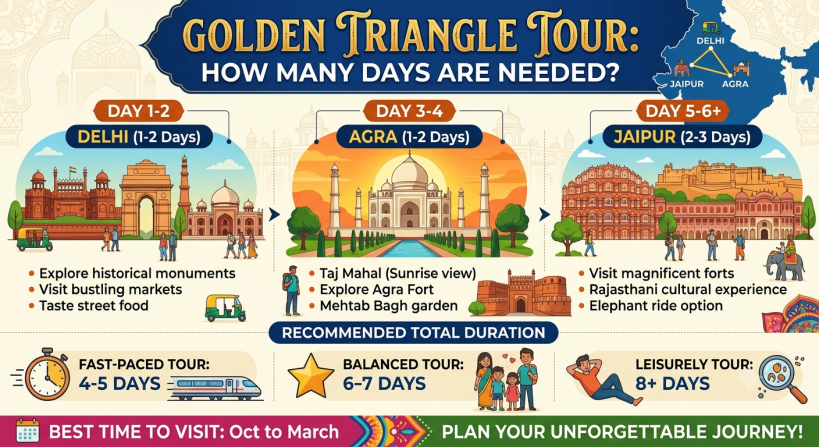
Planning a trip to India and wondering how many days are needed for the Golden Triangle Tour? The classic Golden Triangle circuit covers three of India’s most iconic destinations—Delhi, Agra, and Jaipur—each offering a unique mix of history, culture, architecture, and local experiences. While it is possible to cover the highlights in just a few days, allowing enough time for each city can make the journey much more comfortable and enjoyable.
Ask ten people how long to spend on India’s most famous circuit and you will hear ten different answers. One traveler swears three days is plenty; Another says a week barely scratches the surface. Both can be right, because the ideal length of a Golden Triangle trip depends on what you want to see, how fast you like to travel, and how much of each day you are happy to spend in a vehicle.
This guide breaks the question down in plain terms. You will find what each trip length realistically allows, how much time each city deserves, which factors quietly stretch or shrink your schedule, and how to choose the right number of days for your own style of travel.
How Long Should You Plan?
If you want a quick rule for the Golden Triangle, here it is:
· 3 days: The bare minimum. Rushed, but possible if time is tight.
· 4 days: A solid minimum for most visitors who want to see the headline sights without feeling chased.
· 5 to 6 days: The sweet spot for the classic Golden Triangle circuit, with breathing room and a few extras.
· 7 days: Comfortable and relaxed, with space for side trips and slower mornings.
· 8 to 10 days: Ideal if you want to extend into wider Rajasthan or add wildlife.
Most travelers who want to enjoy the trip rather than simply complete it land on five or six days. Let us look at why.
First, What Does the Golden Triangle Include?
The Golden Triangle links three cities in northern India: Delhi, Agra, and Jaipur. Plotted on a map they form a rough triangle, hence the name. Altogether, the circuit adds up to around 720 kilometers on the road.
· Delhi to Agra: about 230 km
· Agra to Jaipur: about 240 km
· Jaipur back to Delhi: about 270 km
Each city has its own character. Delhi blends Mughal and colonial history with a lively modern capital. Agra is home to the Taj Mahal and a cluster of royal Mughal monuments. Jaipur, the Pink City, brings Rajput forts, palaces, and bustling bazaars.
The distances look short on paper, but road conditions, traffic, and sightseeing stops mean you should treat each leg as a half-day journey rather than a quick hop. Keeping that in mind helps you plan realistically.
What Decides the Right Number of Days for a Golden Triangle Trip?
Before picking a number, consider the factors that shape your schedule.
Your pace. Some travelers love an early start and a packed day. Others prefer a leisurely breakfast, one big sight, and an evening stroll. Neither approach is wrong, but they lead to very different trip lengths.
Travel time between cities. A full day of sightseeing and a four-hour drive do not fit comfortably together. On each transfer day, expect to lose half your daylight.
Your interests A casual sightseer can cover the main monuments quickly. A history lover, photographer, or food enthusiast will happily linger.
The season in the hot months, you will want to rest in the afternoon, which shortens your useful sightseeing hours. In winter, mornings can be foggy, which sometimes delays departures.
Who is traveling Families with children and older travelers usually need a slower rhythm than a young couple or a solo backpacker.
Jet lag If you are flying in from far away, your first day is often a write-off. Many experienced travelers add a buffer day at the start.
A 3-Day Golden Triangle Tour: Fast and Focused
Three days is the shortest Golden Triangle option that still touches all three cities. It works, but you will spend a significant share of your time on the road.
A typical 3-day flow:
· Day 1: Early Delhi sightseeing, then a drive to Agra and sunset views near the Taj Mahal.
· Day 2: Sunrise at the Taj Mahal, a visit to Agra Fort, then a drive to Jaipur with a stop at Fatehpur Sikri if time allows.
· Day 3: Amber Fort, City Palace, and Hawa Mahal in Jaipur, then return to Delhi late in the day.
Best for: Travelers on a layover, business visitors with a spare weekend, or anyone returning to India who has seen some of it before.
Trade-off: Delhi gets very little attention, and you may feel you saw monuments through a car window. If you can add even one day, do it.
A 4-Day Golden Triangle Tour: The Practical Minimum
Four days on the Golden Triangle gives you a day for each city plus a flexible half-day for transfers. This is the format many first-time visitors choose, and it feels far less rushed.
A typical 4-day flow:
· Day 1: Arrive in Delhi; explore Old Delhi, the Red Fort, and Jama Masjid.
· Day 2: See New Delhi’s highlights such as Humayun’s Tomb and Qutub Minar, then travel to Agra.
· Day 3: Taj Mahal at sunrise, Agra Fort, then the drive to Jaipur.
· Day 4: Jaipur’s main attractions, then onward travel.
Best for: First-timers with limited leave, couples on a short getaway, and travelers who prefer a focused plan.
A 5-Day Golden Triangle Tour: Balanced and Comfortable
Five days is where the Golden Triangle experience shifts from “checking boxes” to “actually enjoying the trip.” You gain a full extra day, which can be spent where it matters most.
What the extra day can do:
· Give Delhi a full day of sightseeing instead of a rushed half-day.
· Add Fatehpur Sikri on the road from Agra to Jaipur.
· Allow a relaxed evening in Jaipur’s old city and bazaars.
· Build in a rest period after long drives.
A typical 5-day flow:
· Day 1: Arrive in Delhi and rest.
· Day 2: Full Delhi sightseeing.
· Day 3: Drive to Agra, visit Agra Fort, and see the Taj at sunset.
· Day 4: Sunrise at the Taj, drive to Jaipur via Fatehpur Sikri.
· Day 5: Explore Jaipur’s forts, palaces, and markets, and then return to Delhi.
Best for: Most travelers. Families, couples, solo visitors, and small groups all find this a comfortable balance.
A 6-Day Golden Triangle Tour: Room to Breathe
Six days on the Golden Triangle adds slack into the schedule. That extra time often makes the difference between a trip you remember fondly and one you remember as tiring.
Ways to use the sixth day:
· A second day in Jaipur for the City Palace, Jantar Mantar, and a cooking class.
· A relaxed day in Agra to see Itimad-ud-Daulah, Mehtab Bagh, and local crafts.
· A visit to the step well at Abhaneri, a striking structure on the Agra to Jaipur road.
· A buffer day in case of delays, weather, or fatigue.
Best for: Photographers, families who want shorter driving days, and anyone who likes to travel without watching the clock.
A 7-Day Golden Triangle Tour: Unhurried and Flexible
A week on the Golden Triangle gives you flexibility to travel at an easy pace and add side experiences. You can spend two nights in each city and still have time to spare.
What a 7-day plan can include:
· Two full days in Delhi, covering both Old and New Delhi.
· A full day and a half in Agra, including a Taj Mahal sunrise and a quiet second visit to nearby sights.
· Two days in Jaipur with time for markets, museums, and a local meal.
· An optional wildlife safari at Ranthambore National Park, roughly a few hours from Jaipur.
Best for: Travelers who dislike rushing, older visitors, and families with young children.
Extending the Golden Triangle beyond 7 Days: 8 to 10 Days
Eight to ten days lets you stretch the circuit into a broader Rajasthan or northern India journey.
Popular add-ons:
· Udaipur: The “City of Lakes” with palaces and serene evenings by the water.
· Jodhpur: The Blue City, dominated by the imposing Mehrangarh Fort.
· Pushkar: A small, spiritual lake town with a famous camel fair season.
· Varanasi: One of the oldest living cities in the world, reached by a short flight.
· Ranthambore: A well-known national park where tigers can sometimes be spotted.
An extended Golden Triangle circuit gives you a richer taste of the region without feeling hurried. Many repeat visitors say the extra days were the best part of the trip.
How Much Time Does Each Golden Triangle City Deserve?
If you are building your own Golden Triangle schedule, here is a rough guide to how much time each place needs.
Delhi: 1 to 2 days. One day covers the greatest hits. Two days lets you explore deeper, including food streets, museums, and markets.
Agra: 1 to 1.5 days. The Taj Mahal and Agra Fort can be done in a day, but a sunrise visit combined with an afternoon at Itimad-ud-Daulah feels far less hurried.
Jaipur: 1.5 to 2 days. Jaipur has the most to see. Amber Fort alone can take a good half-day, and the old city rewards slow exploration.
Fatehpur Sikri: 2 to 3 hours. This abandoned Mughal capital sits close to Agra and is best treated as a stop on the way to Jaipur.
The Hidden Time Drains Most Golden Triangle Travelers Forget
Golden Triangle plans often look perfect on paper and fall apart in practice. These small factors quietly eat into your time.
· Traffic on city exits. Leaving Delhi or Jaipur during peak hours can add an hour to your journey.
· Security queues. Popular monuments, especially the Taj Mahal, have entry checks that take time.
· Meal and rest stops. Roadside breaks add up over long drives.
· Shopping and photography. Jaipur’s bazaars and Agra’s craft workshops tend to be longer detours than expected.
· Weather and fog. Winter mornings can delay both road and rail travel.
When estimating your trip length, add a small buffer to each day. A schedule that looks relaxed on paper usually ends up just right in real life.
Car, Train, or Flight: Does It Change Your Golden Triangle Schedule?
Your mode of transport can slightly change how many days you need.
By road: A private car gives flexibility and door-to-door convenience. Delhi to Agra usually takes close to four hours, while the stretch from Agra to Jaipur can run to five.
By train: The fast train between Delhi and Agra takes under two hours, which saves valuable time on the first leg. Train timings are fixed, so you will need to plan around them.
By a mix of both: Many travelers take a train for the first leg and a car for the road to Jaipur. This often saves a couple of hours without losing the scenic drive.
None of these options will shrink your itinerary dramatically, but smart transport choices can free up a few extra hours for sightseeing.
How the Season Affects Your Golden Triangle Schedule
Weather quietly shapes how many Golden Triangle days feel comfortable.
· October to March: Pleasant temperatures make long sightseeing days easy. This is peak season, so book early.
· April to June: Heat can be intense. Start early, rest in the afternoon, and consider adding an extra day to avoid midday exposure.
· Monsoon months (July to September): Expect humid days and the odd heavy shower, so keep a little slack in case rain disrupts a sightseeing plan.
If you are traveling in the hotter months, a six or seven day plan feels noticeably more comfortable than a rushed four-day sprint.
Choosing Your Ideal Golden Triangle Length: A Quick Guide
Here is a simple way to decide.
· Short on time and happy to move fast? Choose 3 or 4 days.
· First time in India and want a balanced experience? Choose 5 days.
· Traveling with kids, parents, or grandparents? Choose 6 or 7 days.
· Love photography, history, or food? Choose 6 to 8 days.
· Want to see more of Rajasthan? Choose 8 to 10 days.
If you are still unsure, a thoughtfully designed Golden triangle tour can help you see how the days are distributed across Delhi, Agra, and Jaipur, which makes it easier to judge how much time you personally need.
Common Mistakes When Planning Your Golden Triangle Duration
A few errors come up again and again.
Trying to do too much in three days the route looks short on a map, but road time is real. Rushing leaves little energy for enjoying anything.
Ignoring the Taj Mahal’s weekly closure Fridays are off-limits for regular visitors, so schedule your Agra day around that.
Skipping a buffer day a flight delay, a fog-bound morning, or simple tiredness can upset a tight schedule.
Underestimating Jaipur Many people allow a single afternoon and then wish they had stayed longer.
Not accounting for jet lag. If you land after a long-haul flight, your first day will not be at full energy.
Travel specialists like Star India Tours tend to say that the most enjoyable Golden Triangle itineraries leave a few unplanned hours, because that spare time is what turns a good trip into a great one.
Practical Tips for Getting the Most from Your Days
1. Start early. Monuments are quieter and cooler in the first hours of the day.
2. Keep transfer days light. Plan only one or two sights on days with long drives.
3. Book key tickets and guides ahead of time, especially in peak winter months.
4. Pack comfortable shoes. You will walk more than you expect.
5. Stay flexible. Weather, traffic, and fatigue can all change your plans.
6. Leave one evening free. Wandering a local market often becomes a trip highlight.
Final Thoughts: So, How Many Days Are Needed?
There is no single perfect number for the Golden Triangle, but there is a sensible range. Four days is a workable minimum, five to six days is the sweet spot for most visitors, and seven or more is ideal if you like a slower rhythm or want to add side trips.
Think about your pace, your interests, and who you are traveling with on the Golden Triangle. Then pick the length that leaves you energized rather than exhausted. A well-paced Golden Triangle journey will leave you with memories of the monuments, the food, the people, and the small unplanned moments in between.
Frequently Asked Questions
1. How many days are needed for the Golden Triangle tour?
Most travelers need at least four days, and five or six feel noticeably more relaxed. That window lets you see all three cities without constantly watching the clock.
2. Can I do the Golden Triangle in 3 days?
Yes, it is possible. However, you will spend a large part of each day on the road, and Delhi in particular will feel hurried. If you can manage one more day, the experience improves noticeably.
3. How long should I spend in each city?
A good guide is one to two days in Delhi, one to one and a half days in Agra and one and a half to two days in Jaipur. Fatehpur Sikri needs only a couple of hours.
4. Is 7 days too long for the Golden Triangle?
Not at all Seven days gives you a relaxed pace, time for side trips like Ranthambore or Abhaneri, and flexibility if plans change. It is a popular choice for families and older travelers.
5. Can I add more cities to the Golden Triangle?
Absolutely Popular extensions include Udaipur, Jodhpur, Pushkar, Varanasi, and Ranthambore National Park. These add three to five days to the basic circuit.
6. Does the time of year change how many days I need?
It can. In summer, you may want an extra day to rest during the hottest hours. In winter, the weather is pleasant, but fog can delay morning travel, so a small buffer is wise.
7. Which day of the week should I avoid for the Taj Mahal?
Friday The Taj Mahal does not admit regular visitors that day, so pick any other day for Agra.
APPROVED
Keep the memory. Verify the moving details.
Use this guide as a practical route note, then reconfirm prices, schedules, entry rules and availability close to departure.

Admin
Turzico editors turn destination research into practical, warm and easy-to-use travel notes.